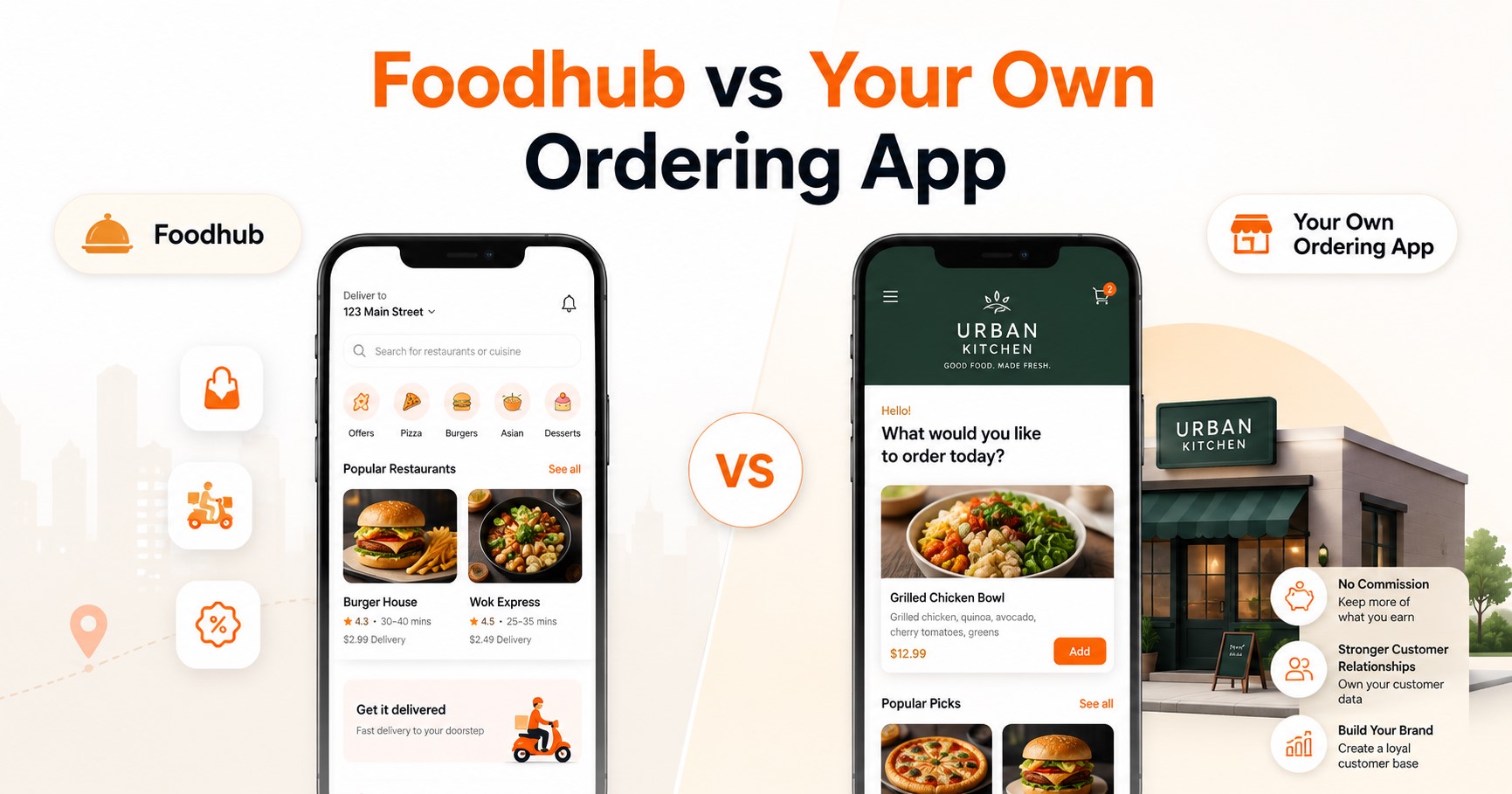
Foodhub and your own brandedfood ordering app are both commission-free, so the real choice is between discovery and ownership. Foodhub puts you in front of an existing customer base inside its marketplace; your own app puts your brand on a customer's home screen and keeps the relationship, the data and the marketing permission with you.
That framing matters because most comparisons on this topic are written as though the alternative to a marketplace is always a percentage-fee platform. It isn't. Foodhub built its UK business specifically on a subscription rather than commission model, and any comparison that ignores this is misleading you.
This guide is for UK restaurant, takeaway and café owners weighing the two. You'll get a factual account of what each actually is, a side-by-side comparison, honest scenarios where each wins, and the questions to ask before signing anything.
What is Foodhub?
Foodhub is a UK-headquartered food ordering company that operates a consumer marketplace alongside a wider restaurant technology suite. It's based in Stoke-on-Trent and its consumer app launched in 2018.
According to figures published on Foodhub's own business site, the company works with over 30,000 restaurant and leisure venue partners, processed more than 60 million orders in 2024, and has over 20 million active customers and more than 1,200 staff worldwide. It describes its marketplace portal as the UK's fourth largest.
Its published partner roster includes national names such as Papa Johns, Subway and TGI Friday alongside independents.
What Foodhub offers partners, per its own materials:
- The Foodhub consumer marketplace portal
- An EPOS system with third-party integrations
- Self-service ordering kiosks
- POS HUB, an integration suite connecting to other marketplaces including Uber Eats and Deliveroo
- My Business Hub, a remote management app for owners
- Marketing support and analytics
On cost: Foodhub markets itself on a commission-free model. Its published note states that marketplace portal listing is free for EPOS partners, available on a rental subscription for marketplace-only partners, and on a commission basis for inventory partners and resellers. Foodhub does not publish standard pricing, so your actual terms come from a quote.
What "your own ordering app" means
Your own ordering app is a branded iOS and Android app, published under your restaurant's name, where customers order directly from you. There's no marketplace, no other restaurants on the screen, and no intermediary between you and the customer.
The components are usually:
- A branded ordering website on your own domain
- Native iOS and Android apps carrying your name and logo
- Your own payment processing, typically Apple Pay or card entry
- A customer database you control and can export
- Push notifications you send
- Loyalty you design
One technical point that matters more than it sounds. Apple's App Review Guideline 4.2.6 states that apps built from a commercialised template or app generation service are rejected unless submitted directly by the provider of the app's content, and that such services should not submit apps on behalf of their clients. In practice this means a genuinely "own" app is published under your own Apple Developer account, not your vendor's.
That distinction is the difference between an app you have and an app you rent. Ask any vendor which account the app will live in.
The real difference isn't commission
Both options remove percentage commission, so comparing them on that basis tells you nothing. This is where most articles on this topic mislead.
Foodhub's entire market positioning is built on charging a subscription instead of a commission. If you're coming from Just Eat, Deliveroo or Uber Eats, both Foodhub and a direct app will feel dramatically cheaper per order.
The four differences that actually separate them:
- Discovery. Foodhub's marketplace has an existing customer base. Your own app has none until you build one.
- Customer ownership. On a marketplace listing, the ordering customer is primarily the platform's customer. On your own app, they're yours.
- Brand position. In a marketplace you appear as a listing among competitors. With your own app, you're an icon on the home screen with nobody else on the page.
- Portability. If you leave a marketplace, the customers generally stay with the marketplace. If you change ordering vendors, your customer list should come with you - provided you checked that before signing.
A UK data point worth knowing. The Information Commissioner's Office is clear that the PECR soft opt-in for marketing emails only applies to contact details you obtained directly from the individual. It does not apply where another organisation obtained them for you, and there is no such thing as a third-party marketing list that qualifies. Which channel collected the customer determines whether you can lawfully email them later.
Side-by-side comparison
FoodhubYour own ordering appPricing modelCommission-free; subscription or EPOS-linked, quoted per venueCommission-free; flat subscription plus card feesBrings new customersYes — established marketplace audienceNo — you supply demandBrand on screenListing within Foodhub's appYour name and logo, standaloneCompetitors visibleYes, alongside your listingNoCustomer dataHeld primarily by the platformHeld by youEmail and push marketingPlatform-controlledYours, with consentApple Developer accountFoodhub'sShould be yours — see guideline 4.2.6Wider tech suiteEPOS, kiosks, integrations, owner appVaries by vendorHardware includedEPOS and kiosk options availableUsually notBest atAcquisition and operationsRetention and margin
Where Foodhub is the better choice
Be honest about which of these describes you. If two or more do, a marketplace is probably the right first move.
- You're new or newly relocated. No customer base means a direct app has nobody to talk to. Marketplace discovery is genuinely valuable here.
- You need EPOS and kiosks too. A bundled ecosystem with hardware, integrations and one support line is simpler than assembling four vendors. That's a real operational advantage.
- Your volume is low. Below a certain order count, the fixed cost of running your own channel plus the marketing to fill it isn't yet justified.
- You want to consolidate existing marketplaces. Foodhub's integration suite connects other marketplace orders into one system, which solves the multiple-tablets problem.
- You have no marketing capacity. A direct app only works if somebody actively promotes it. If nobody in your business has time for that, you'll get more from a marketplace.
Where your own app is the better choice
- You already have loyal regulars. They'll download an app for a restaurant they love. That's the whole game.
- Repeat frequency is high. Coffee shops, lunch spots and local takeaways with weekly customers get compounding value from a home-screen icon.
- You want a customer list you can market to. Collected directly, with consent, it's an asset that grows every month and moves with you.
- Your brand matters commercially. If customers choose you specifically rather than browsing for whatever's nearby, a listing among competitors works against you.
- You want to control the offer. Your own discounts, your own loyalty design, your own price presentation, no platform rules.
- You're planning to sell the business eventually. A direct customer base is a transferable asset in a way that a marketplace listing isn't.
The ownership test
Five questions. Ask them of any platform, including your own vendor. The answers tell you what you're actually buying.
- Whose Apple Developer account will the app be published under? If the answer is the vendor's, it isn't your app.
- Can I export my full customer list, including email addresses and order history, at any time? Ask for it in writing.
- If I leave, what happens to customers who ordered through this channel? The answer is very different for a marketplace listing and a branded app.
- Who obtained the customer's contact details for data protection purposes — me or the platform? This determines whether you can lawfully email them.
- Can I send push notifications and emails on my own schedule, with my own content? Or does the platform control the calendar?
Can you run both?
Yes, and for most established operators it's the strongest position. The two channels do different jobs and don't cannibalise each other the way two marketplaces do.
The working model:
- Marketplace handles discovery. New customers find you, place a first order, try the food.
- Your own app handles retention. In-bag inserts, QR codes and a launch offer move repeat customers across.
- You measure the split monthly and watch direct share grow.
The context supports this. Lumina Intelligence values the UK foodservice delivery market at £14.8bn for 2026, growing 2.8% year on year — steady rather than booming. In a market growing that slowly, margin comes from where you take the order, not from waiting for the tide.
One caution: check any exclusivity or price-parity terms before listing on multiple platforms. These vary between agreements and are negotiated per venue.
Questions to ask before you sign
Take this to both conversations.
Cost
- What is the total monthly cost including any hardware, and what triggers it changing?
- What are the card processing rates, and are they separate from the subscription?
- Is there a minimum term, and what notice do I give to leave?
Ownership
- The five ownership-test questions above
- Whose name appears on the App Store listing?
Operations
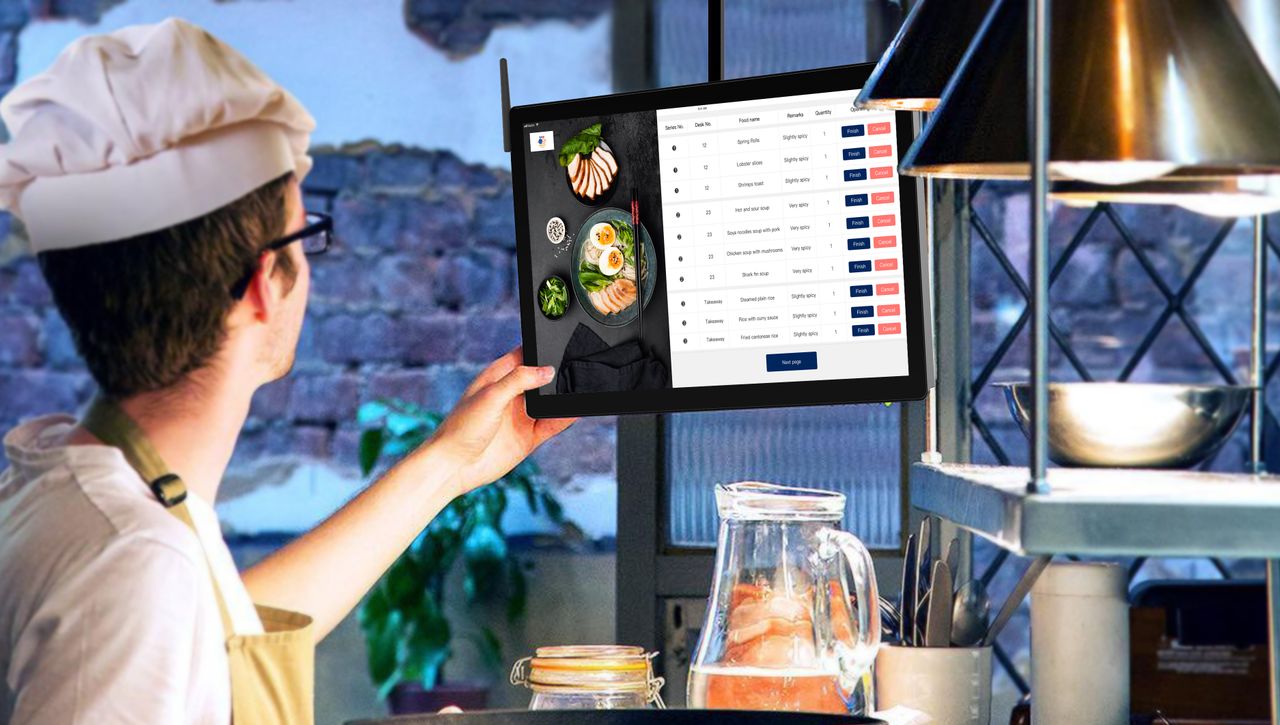
- How do orders reach my kitchen, and can they arrive on one screen with everything else?
- What happens at 8pm on a Friday when something breaks?
- Does it handle eat-in and takeaway VAT correctly per line item?
Marketing
- Who can contact my customers, and how often?
- Do I control discounting, or does the platform?
Get the answers in writing. A sales call is not a contract.
FAQs
Does Foodhub charge commission?
Foodhub markets itself on a commission-free model, using subscription-based pricing rather than a percentage of each order. Its published terms note that marketplace listing is free for EPOS partners, available on a rental subscription for marketplace-only partners, and on a commission basis for inventory partners and resellers. Get your specific terms quoted in writing.
Is Foodhub better than having my own app?
It depends on whether your problem is discovery or retention. Foodhub's marketplace brings customers you don't currently have. Your own app keeps customers you already have and gives you the data. New businesses usually benefit more from the first; established ones from the second.
Who owns customer data on a marketplace?
Customer relationships built inside a marketplace generally belong primarily to the platform. This has practical consequences under UK law — the ICO's guidance is that the PECR soft opt-in for marketing only applies where you collected the contact details directly yourself. Ask any platform for its data export policy in writing before signing.
Can I use Foodhub and my own ordering app at the same time?
In most cases yes, and many operators do. The marketplace handles discovery while the branded app handles repeat business. Check your agreement for any exclusivity or price-parity terms first, as these vary per venue.
Does Foodhub give you your own branded app?
Foodhub offers a wider technology suite including EPOS, kiosks and online ordering alongside its marketplace. If a branded app matters to you, ask specifically whose Apple Developer account it would be published under — Apple's guideline 4.2.6 requires template-built apps to be submitted by the provider of the app's content, and the answer tells you how much of the app is genuinely yours.
How many restaurants use Foodhub?
Foodhub's business site states over 30,000 restaurant and leisure venue partners, more than 60 million orders processed in 2024, and over 20 million active customers.
What happens to my customers if I leave a platform?
On a marketplace, customers generally remain with the marketplace — they discovered you there and will browse there again. On your own branded channel, the relationship should transfer with you, provided your contract grants full data export. Confirm that clause before you sign, not when you leave.
Summary
Foodhub and your own ordering app are both commission-free, so the honest comparison is discovery versus ownership - not fees.
Foodhub brings an established marketplace audience, a bundled technology suite with EPOS and kiosks, and integrations that consolidate other platforms into one system. That's a strong answer for operators who need volume, hardware, or both.
Your own app brings no new customers, but every customer it does bring is yours: your brand on the home screen, your data, your marketing permission, your asset if you sell. That's the stronger answer for operators who already have regulars.
The deciding question is simple. Is your problem that not enough people know you, or that the people who know you are ordering somewhere you don't control? Answer that honestly and the choice makes itself. And for a great many established operators, the right answer is both, marketplace for discovery, your own channel for everything after the first order.
Ready to grow your food business?
Online ordering system, a branded restaurant ordering app, table booking and EPOS on one platform, with plans from £19/month.