Your takeaway delivery radius should cover addresses you can serve safely, reliably and profitably during your busiest normal service periods. Start with a small tested area, then expand only when journey times, food condition and delivery costs support each addition.
Picture Friday at 7pm. Orders arrive, the kitchen gets busy, and your driver collects another bag.
One customer lives nearby, beyond a slow railway crossing. Another lives farther away, along a clear main road.
Which order reaches the door first? The map alone cannot tell you.
For UK takeaway owners, this guide explains how to choose an area your team can confidently serve. Government delivery guidance, published in 2020, covers 14 allergens and two stages for providing allergen information.
We combine that guidance with a clearly labelled planning example, route checks and a practical delivery worksheet.
What Is a Takeaway Delivery Radius?
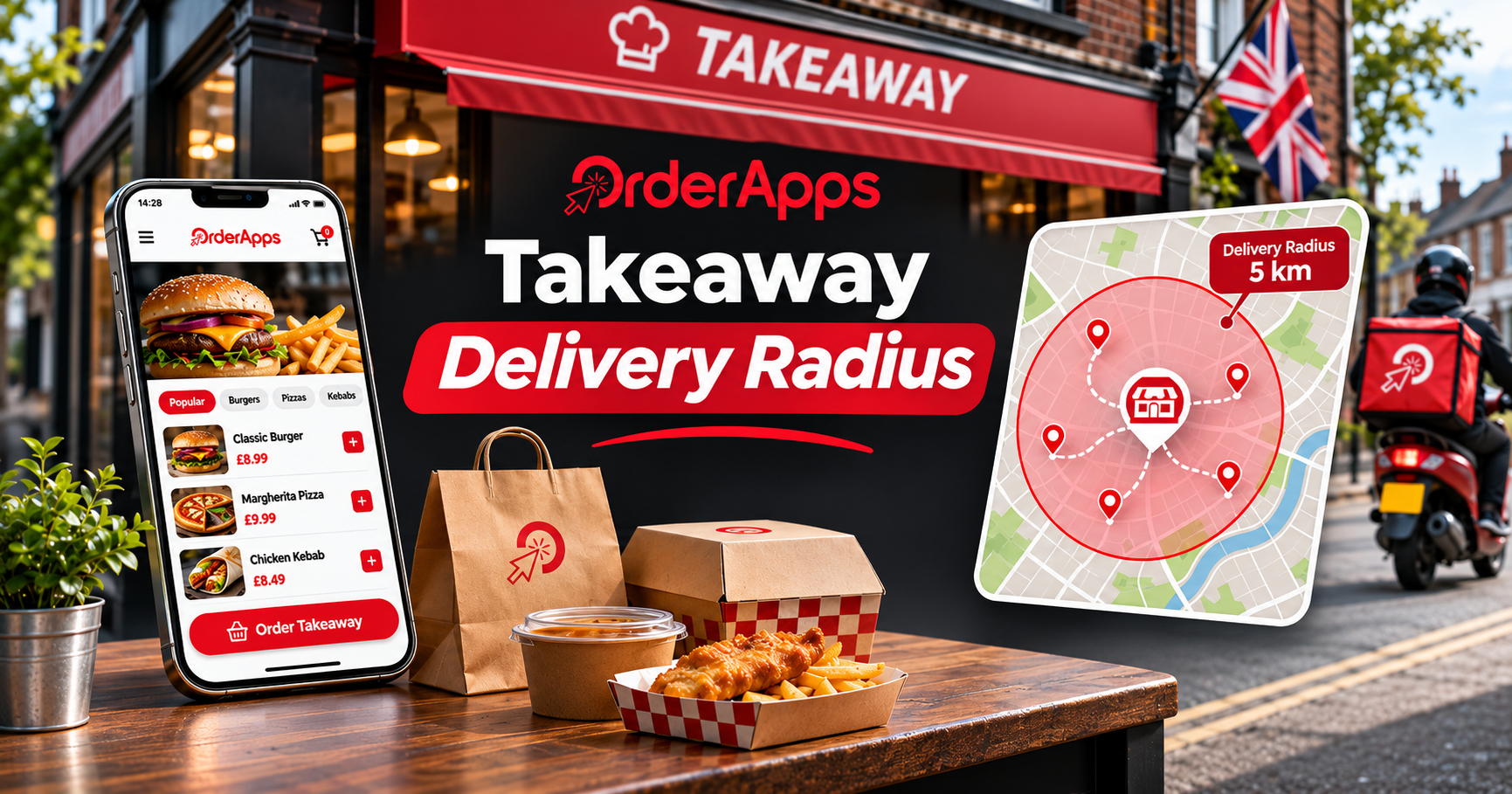
A takeaway delivery radius is the distance boundary around your premises within which you accept delivery orders. However, a simple circle measures geographic distance. Your actual service area should also reflect road access, journey times, driver capacity, food safety and the condition customers expect.
Imagine drawing a circle around your shop. Every address inside appears equally accessible.
Now add a river, one-way streets and a busy junction. Suddenly, the circle contains several very different journeys.
That is why delivery distance needs an operational check. A nearby address can require a longer journey than a more distant postcode.
Your takeaway delivery radius should describe a service you can deliver consistently. It should give your kitchen, drivers and customers clear expectations.
How Far Should Your Takeaway Deliver?
Your takeaway should deliver only as far as your tested preparation, dispatch and travel times allow. Choose addresses where food arrives safely, meets your quality standards and leaves a worthwhile contribution after delivery costs. There is no single mileage figure that suits every menu, location or delivery team.
If you need a starting point, select nearby addresses along straightforward routes. Treat this as a trial boundary, rather than a final recommendation.
Then test several directions from your premises. Include your busiest normal service period.
Start With Your Hardest Route
Choose an address near your proposed boundary. Look for the route most likely to delay your driver.
Check for:
- Busy junctions and railway crossings.
- Limited parking.
- Flats with entry systems.
- Pedestrian areas.
- Roads affected by school traffic.
- Difficult return journeys.
Picture your driver reaching a block of flats. Parking takes three minutes, and the customer needs another two minutes downstairs.
Those five minutes belong in your delivery plan. They also affect the next customer waiting for an order.
Calculate Your Delivery Time Budget
Your delivery time budget includes every stage between order acceptance and customer handover. Work backwards from your promised arrival window to establish how much time remains for travel.
Time available for driving = promised delivery time − preparation − packing − dispatch waiting − doorstep handover − contingency.
The following example shows the method. These figures are illustrative, rather than measured OrderApps customer results.
StageExample allowancePreparation and packing18 minutesWaiting for dispatch5 minutesParking and handover4 minutesContingency5 minutesAvailable outward driving time13 minutesTotal delivery allowance45 minutes
At 7pm, your team accepts an order. Preparation and packing finish at 7:18pm.
The driver leaves at 7:23pm. A 13-minute drive brings them nearby at 7:36pm.
Parking and handover take four minutes. The customer receives the order at 7:40pm, leaving five minutes of contingency.
Now imagine that drive takes 22 minutes during traffic. The same order reaches the customer at 7:49pm.
That address does not fit this example’s 45-minute promise. You need a different boundary, operating plan or clearly communicated delivery window.
A delivery promise is a service commitment, not a food safety limit. Your food safety procedures require separate validation.
Compare Your Delivery Zone Options
Choose delivery zones that match your local roads and available ordering settings. Radius, postcode and custom boundaries each offer different levels of control.
MethodHow it worksUseful whenMain checkRadiusDraws a circle around your premisesNearby routes behave similarlyStraight-line distance can hide detoursPostcode zonesIncludes selected postcode areasYou serve recognisable local areasOne postcode may contain different journey timesCustom boundariesFollows a chosen map shapeRoads, rivers or access restrictions matterConfirm platform support and boundary accuracy
Picture two estates beside your takeaway. One connects directly to the main road.
The other requires a long loop around a railway line. Including both under one distance rule may create inconsistent arrival times.
Where your platform supports suitable boundaries, separate these areas. Otherwise, choose a conservative radius and check the addresses near its edge.
Keep Customer Rules Clear
Show customers whether their address qualifies before they complete payment. Make delivery charges, minimum orders and expected arrival times easy to understand.
Test addresses just inside and outside each boundary. Check that the website applies the intended rules.
Yourtakeaway ordering system should support a clear delivery and collection journey.
Test Your Food and Packaging
Test food using the packaging and transport conditions your drivers actually use. Check safety through your food safety procedures, then assess appearance, texture and presentation separately.
Governmentfood delivery safety guidance states:
“Food that needs refrigerating must be kept cool while being transported.”
The guidance also recommends insulated bags for food requiring hot transport. Its stated coverage includes England, Wales and Northern Ireland.
For Scotland, check Food Standards Scotland guidance and your local authority’s requirements.
Follow One Order to the Door
Pack a representative order during normal service. Include a dish that travels less well alongside a popular bestseller.
Record when packing finishes. Follow the proposed route, including realistic parking and handover time.
Then assess:
- Container condition and leakage.
- Food presentation.
- Texture and condensation.
- Separation of hot and cold items.
- Temperature checks required by your food safety plan.
- Clear identification of meals with allergy requirements.
Appearance, smell and taste cannot confirm food safety. Use appropriate controls, records and competent advice.
UKtakeaway allergen guidance requires information about the specified allergens before purchase and upon delivery. Keep that process consistent across your delivery area.
If a dish travels poorly, investigate packaging first. You might also adjust delivery availability, journey limits or dispatch arrangements.
Check Your Delivery Costs
Calculate delivery costs using the full driver cycle, including the return journey. Then compare those costs with the contribution available from each order.
A driver’s job continues after handing over the bag. They still need to return or reach the next collection point.
Consider this simplified example:
Cost or contributionExample amountContribution before delivery£9.00Delivery fee collected£3.00Driver time: 30 minutes at £15/hour£7.50Allocated vehicle costs£1.00Remaining contribution£3.50
These are planning assumptions, not wage recommendations or industry averages. Use a consistent VAT basis and your actual costs.
The £9 contribution assumes you already deducted food, packaging, discounts and order-related charges. The remaining £3.50 still needs to support fixed overheads and profit.
Now extend the driver cycle to 45 minutes. Driver time rises to £11.25 under the same assumption.
The remaining contribution becomes minus £0.25, even before any additional vehicle costs.
Your takeaway delivery radius therefore affects more than fuel. It changes how much driver capacity each order consumes.
Compare Orders Fairly
Use similar basket values when comparing delivery zones. Otherwise, a large outer-zone order can hide an expensive route.
Also distinguish customer delivery fees from actual delivery costs. A £3 charge does not prove that a delivery costs £3.
Shared delivery runs can improve efficiency. However, check every customer’s additional waiting time before combining drops.
Run a Seven-Day Delivery Trial
Use a short delivery trial to identify problems before expanding coverage. Seven days can provide an initial view, but unusual weather or limited orders may require further testing.
The following schedule is a suggested process. It is not a validated industry benchmark.
- Map candidate addresses. Choose different directions and difficult boundary locations.
- Record preparation times. Include a busy service, rather than quiet periods alone.
- Test outward journeys. Record actual routes, parking and handover.
- Validate food transport. Follow your food safety plan and assess presentation.
- Calculate driver cycles. Include return travel and waiting.
- Test checkout rules. Check accepted addresses, fees, minimum orders and collection.
- Review the evidence. Keep suitable addresses and investigate inconsistent routes.
Copy This Delivery Worksheet
Use one row per test or delivery. Keep personal customer information out of shared planning documents.
FieldWhat to recordTest referenceInternal identifierAreaPostcode sector or route labelService conditionsDay, time, weather and trafficOrder timingAccepted, packed, dispatched and deliveredDriver cycleDispatch to availability for another orderFood checksSafety records and presentation observationsDelivery economicsFee, allocated costs and contributionDecisionKeep, retest or exclude
Record delayed orders as carefully as successful ones. You need to understand the conditions behind each result.
Set Up Your Online Ordering
Apply your tested delivery rules before promoting the service. Check the complete customer journey using addresses near every boundary.
OrderApps’online ordering system supports delivery and collection settings, scheduled orders, delivery zones and minimum order values. Confirm the configuration you need during setup.
Run these checks:
- An eligible address can place an order.
- An excluded address receives a clear explanation.
- Delivery charges match your intended settings.
- Minimum order rules work correctly.
- Collection remains clearly available.
- Delivery windows reflect kitchen capacity.
- Your team receives the correct delivery details.
Then place an end-to-end test order. Follow it from checkout through kitchen preparation to dispatch.
OrderApps’restaurant EPOS system brings online, phone and counter orders into one system. This helps your team see incoming demand together.
For broader setup guidance, read ourcomplete takeaway ordering system guide.
Review Your Takeaway Delivery Radius
Review your takeaway delivery radius whenever results suggest your current area needs adjustment. Changes in staffing, traffic, menus or order volume can affect previously reliable routes.
Track:
- Deliveries completed within the stated window.
- Packing-to-handover time.
- Driver waiting and return time.
- Food condition complaints.
- Refunds and remakes.
- Contribution by delivery area.
Expand one area at a time. Keep other major settings stable where possible, so you can understand the effect.
If outer-zone orders repeatedly arrive late, investigate the cause. A dispatch delay needs a different response from a difficult road route.
A higher delivery fee cannot fix food that arrives in poor condition. Resolve the operational issue before keeping that area open.
Choose Coverage You Can Confidently Serve
The right takeaway delivery radius balances safe food transport, reliable arrival times and worthwhile delivery economics. Start with tested routes, record the full order journey, and expand using evidence.
Picture the same Friday-night service again. Your kitchen knows the workload, your driver knows the route, and your customer sees a realistic arrival window.
That is the outcome your delivery boundary should support.
Want help setting up direct ordering around your delivery area?Book a free OrderApps demo to discuss your menu, delivery settings and collection options.
Frequently Asked Questions
Is Three Miles a Good Delivery Radius?
Three miles can be a useful trial boundary, but it is not a universal recommendation. Check actual journeys during your busiest service. Include preparation, dispatch waiting, parking and handover. Keep the area only when food safety, quality and delivery costs support it.
Can a Takeaway Deliver Five Miles?
A takeaway can consider five-mile deliveries when routes, food transport controls and delivery economics support that distance. Test the complete journey before opening the area. A clear road may work better than a shorter congested route. Mileage alone cannot confirm whether a delivery is suitable.
Should Delivery Charges Increase With Distance?
Delivery charges can increase when longer routes create higher costs. However, compare full driver cycles rather than mileage alone. Review basket contribution and minimum order values alongside the fee. Make charges clear before payment, and check that the resulting offer remains useful to customers.
Does a Larger Delivery Area Increase Profit?
A larger delivery area creates more potential customers, but it does not automatically increase profit. Longer journeys consume driver capacity and may increase delivery costs. Compare the contribution from additional orders with their operational demands. Expand only when the results justify the extra coverage.
How Often Should Delivery Areas Be Reviewed?
Review delivery areas regularly and whenever operating conditions change. Check new menus, staffing changes, roadworks and seasonal demand. Review new zones closely during their trial period. Use recorded journey times, food checks and delivery costs to decide whether each area should remain available.
Can Customers Collect Outside the Delivery Area?
Customers outside your delivery area may still order collection if you offer that service. Present collection clearly when delivery is unavailable. Show the collection address, opening hours and estimated preparation time. Test your checkout to confirm that delivery restrictions do not accidentally block collection.
Editorial note: The route timings, costs and trial schedule are illustrative planning tools. Validate food transport through your food safety procedures and local authority advice.
Ready to grow your food business?
Online ordering system, a branded restaurant ordering app, table booking and EPOS on one platform, with plans from £19/month.